


For a decade, the promise of Open Source has been quietly and systematically hollowed out by corporate extraction and bureaucratic cowardice.
We had magnificent proofs of concept written into the very bedrock of the modern world.
We had the Apache HTTP Server, which organically grew to power the explosion of the early web, and the foundational architecture of Linux.
We had Tim Berners-Lee’s definitive 1993 declaration that the source code of the World Wide Web would enter the public domain without royalties, ensuring the internet remained a common utility rather than a corporate fiefdom (Berners-Lee, 1999; Fielding et al., 1999).
It was a beautiful script. But like most secular faiths of the early digital age, its lines began to blur under the steady, historical pressure of power and capital—a distortion that has become particularly acute within modern public and EU research frameworks.
Over the last decade, that promise has been quietly, systematically hollowed out. What we still occasionally celebrate in standard industry keynotes as “open collaboration” has settled into something far more cynical: a shifting territory split between predatory corporate extraction on one side and a blank, bureaucratic compliance on the other.
Niccolò Machiavelli warned in The Prince that those who rely entirely on the perceived virtue of others, rather than their own structural defenses, are merely arranging their own ruin. We forgot that. We forgot that power, when left to its own devices without an explicit, adversarial architecture to contain it, will always pool where the capital is heaviest.
I know this because I spent ten years watching the ink dry on agreements that meant nothing. For more than a decade, my team and I poured our energy, our specialized expertise, and a specific technical vision into building advanced, distributed infrastructure. We believed we were feeding a shared well. Instead, we received a forensic education in how easily an un-architected ecosystem can be hijacked. We watched an incumbent corporation use the sheer mass of its market position to freeze out radical innovations—simply to protect the margins of its legacy products—while pocketing the economic yield of our collective labor. The developers pushing the technical envelope received the burnout; the legacy gatekeepers took the ledger.
We will not repeat that mistake. From this point forward, we lean into a different paradigm: one rooted in open innovation and a radical, structural meritocracy. Crucially, this does not mean retreating into an idealistic, non-commercial monasticism. We are not looking to become ideological martyrs. To build an ecosystem that actually endures—and to command the elite developer resources required to push deep tech forward—the architecture must provide a transparent, sustainable path to monetization and economic return. True meritocracy cannot survive on exposure and goodwill alone; it requires an equitable, self-sustaining loop where value created is value returned.
And if you are currently attempting to build the future of software infrastructure, you cannot afford to repeat the old mistakes either. To fix the mechanism, we must first look clearly at the ways it breaks down.
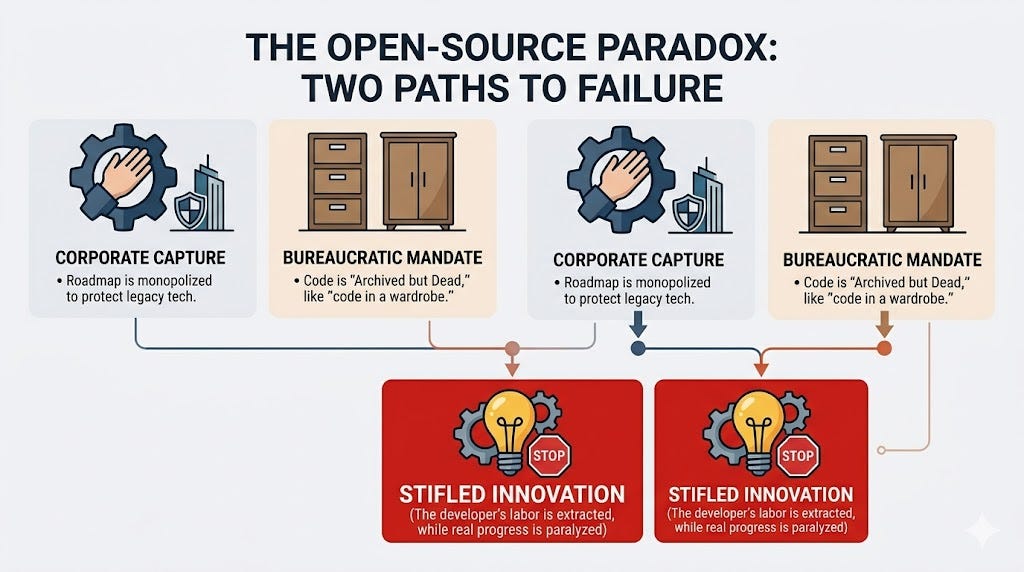
When an open-source project becomes heavily steered by a single or a group of enterprises with a hidden commercial balance sheet, the social contract of the community shifts. It becomes a model of quiet, predatory extraction. Outside contributors submit brilliant, highly optimized code only to watch it sit indefinitely in pull-request limbo because its very efficiency poses a threat to the controlling corporation’s proprietary, risk-averse roadmap.
The enterprise behaves exactly like the Machiavellian prince who enters a free city: they do not openly dismantle the local customs; they simply corrupt them from within, using the community as a subsidized R&D department. The purpose of this system is not open innovation; it is the algorithmic extraction of free intellectual labor to feed a corporate balance sheet. They package the independent labor of outsiders into commercial SaaS or premium enterprise editions, leaving the original creators with nothing but a badge on a profile and a deep sense of fatigue. Their technical sovereignty is traded away to a modern feudal lord, wrapped in the language of sharing.
On the other side of this terrain lies the bureaucratic failure mode, a phenomenon familiar to anyone who has navigated the large-scale, publicly funded consortia of Europe. These initiatives are rich with noble prose about “Open Science” and carry strict legal mandates requiring all resulting software to be published under open-source licenses.
But public mandates cannot legislate human desire.
In practice, these consortia treat open source as an administrative finish line rather than an engine for growth. They dump the code into a public repository to satisfy the technical reviewers, check the compliance box, and walk away. This is what we have come to call the “Code in a Wardrobe” anti-pattern. The repository is technically public, but it is functionally invisible, dead, and entirely devoid of human engagement.
If the purpose of a system is what it does, then the purpose of the EU project infrastructure is simply the preservation of bureaucracy—the transmutation of public grants into unread PDF reports and dead GitHub repositories.
This state of profound stagnation brings to mind Dante Alighieri’s description of the Ignavi in the Vestibule of the Inferno—those lukewarm souls who lived without disgrace and without praise, rejected by both heaven and hell, moving toward absolutely nothing. The code satisfies the auditors, but because it ignores the feedback loops required to sustain a living community, it sits in the dark, gathering digital dust in a closet no one opens.
Because the conventional rules of corporate-backed foundations do not penalize this kind of extraction, Defection becomes the stable Nash Equilibrium. The system experiences a runaway positive feedback loop—a "Success to the Successful" trap where power and resources accumulate monolithically, starving out the rest of the ecosystem until everyone defaults to doing the absolute minimum required for compliance.
To break this cycle, we do not need better intentions or warmer rhetoric; we need better Mechanism Design. In her seminal work on systems thinking, Donella Meadows identified “the rules of the system” and “the structure of information flows” as among the highest leverage points to fundamentally alter systemic behavior. If you want a system to behave differently, you do not plead with the nodes to be more virtuous; you change its structural rules and feedback loops.
In his Discourses on Livy, Machiavelli noted that a stable republic cannot depend on the continuous virtue of its citizens; rather, it must be architected so that even self-interested men are compelled by the law to act for the common good. We must alter the rules of the game so that honest cooperation is the only mathematical strategy to maximize a participant’s payoff—a property known as Incentive Compatibility.
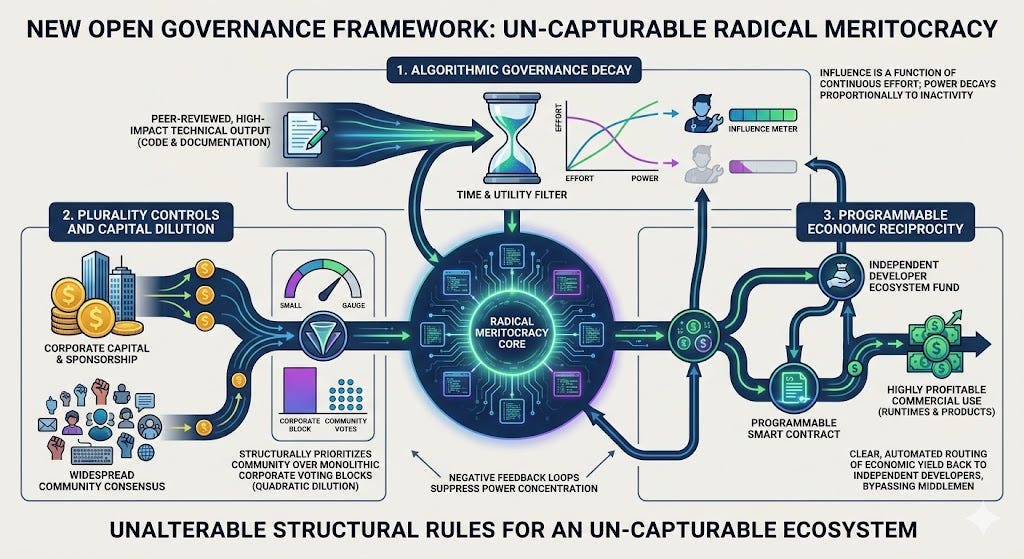
To build an un-capturable, radical meritocracy, our new open governance framework implements three concrete, unalterable structural rules that function as negative feedback loops to suppress concentration of power:
Algorithmic Governance Decay: Influence over the technical roadmap cannot be bought with sponsorship dollars, foundation seats, or corporate titles. It must be a function of continuous, peer-reviewed, high-impact technical output. If an entity stops actively contributing to the core infrastructure, their voting power algorithmically decays over a fixed timeline. This introduces homeostatic balance, ensuring power remains proportional to active utility.
Plurality Controls and Capital Dilution: To prevent a multi-billion-dollar enterprise from buying out the roadmap by flooding the project with internal corporate engineers, we implement non-linear influence mechanics inspired by Quadratic Voting. This structurally prioritizes widespread community consensus over monolithic corporate voting blocks, neutralizing runaway scale advantages.
Programmable Economic Reciprocity: We establish clear cryptographic or contractual boundaries ensuring that if the core technology is utilized in highly profitable commercial runtimes, a clear, automated percentage of that economic yield is routed directly back to an independent developer ecosystem fund, explicitly bypassing corporate middlemen and closing the economic loop.
A mechanism, however elegant, is only as good as the people it attracts. To keep an infrastructure project from stagnating or turning into abandonware, you need to forge an ironclad alliance between two distinct forces. Sun Tzu famously wrote that in battle, one uses the orthodox force (Zheng) to bind the enemy, and the unorthodox force (Qi) to win the day.
In our architecture, we synthesize these dual forces by linking Practitioners with Skin in the Game (the orthodox execution) and Academics with Deep Theoretical Backgrounds (the unorthodox creative breakthroughs).
Ten years of watching corporate roadmaps and administrative mandates paralyze breakthroughs taught us exactly what not to do. But we did not spend a decade in the trenches merely to become professional critics of a broken game. We spent it mapping the fault lines so we could build an architecture that cannot be compromised.
The next chapter does not belong to the legacy gatekeepers who hoard value, nor does it belong to the bureaucratic box-tickers who closet code away like forgotten ghosts in a neglected tomb. It belongs to an intentional, sovereign alignment of builders and thinkers who understand that to change the system, you must change the math.
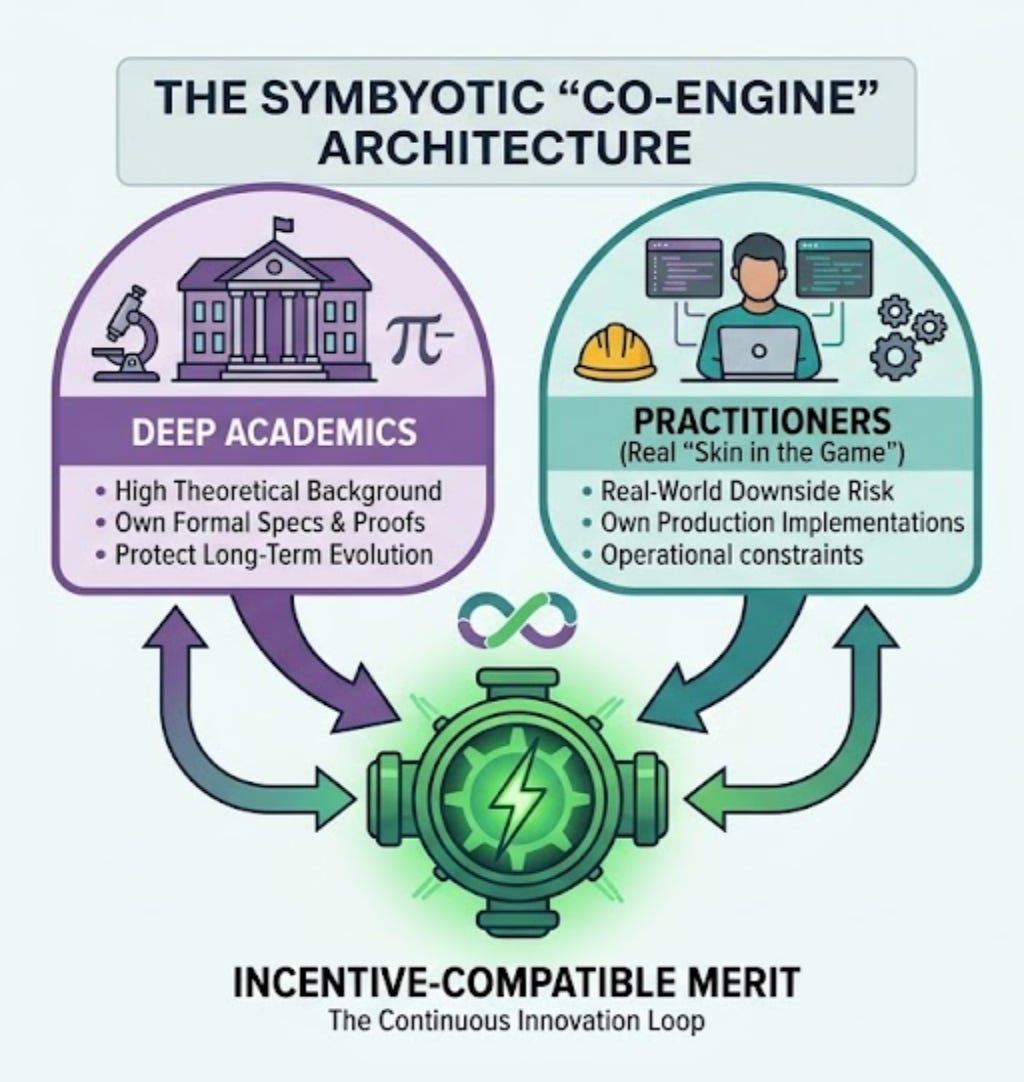
What comes next is a deliberate departure from the old illusions. We are moving past the era of empty compliance and predatory extraction, and moving toward a working alternative—a decentralized ecosystem designed from the ground up to protect technical sovereignty, resist capture, and fuse deep protocol verification with production-grade execution.
This is an open invitation. In the coming weeks, we will be pulling back the curtain on this new framework, sharing the formal specifications, and opening up the engine room to those who have real skin in the game.
If you are tired of pouring your labor into systems that optimize for your burnout, and you are ready to build a future you actually have an un-capturable stake in—stay close. The road is clearing, the architecture is ready, and the door is wide open.
Let’s build open ecosystems that are actually open. Watch this space.
The era of the code artisan and the bureaucratic repository is over. The architecture for true Sovereign Cloud, Data Spaces and services are being deployed. If you have the theoretical rigor to verify protocols and the tactical hunger to execute them, the gates to the engine room are opening.